
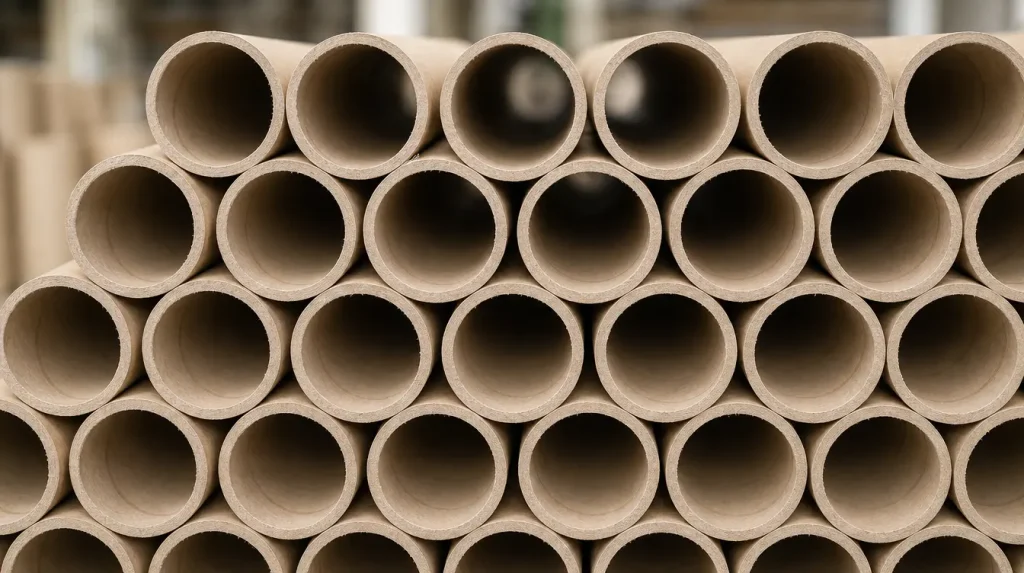
If your business winds, stores or ships anything on a roll, the core at the centre matters more than most people think. The wrong inside diameter won’t fit your machine shafts.
A wall that’s too thin can crush under winding tension, and a core that isn’t perfectly round can cause uneven rolls, wasted material and stoppages on the line.
At Essex Tubes, we’ve been manufacturing spiral wound cardboard cores at our factory in Tilbury, Essex since 1989. Our customers range from film converters and label printers to textile mills and metal stockholders, and the questions they ask us are usually the same: what size do I need, how thick should the wall be, and who should I buy from?
In this guide, we’ll explain what a cardboard core is, run through the most common sizes and wall thicknesses, look at how to choose a core for your industry, and cover what to check before you place an order.
What Is a Cardboard Core?
A cardboard core (also called a paper core, winding core or reel core) is a rigid cylinder that material is wound around. It gives the roll a strong, stable centre so it can be wound, stored, transported and then unwound cleanly on the customer’s machinery.
Our cores are spiral wound. Strips of recycled fibreboard are glued and wound at an angle around a steel mandrel, layer on layer, until the wall reaches the required thickness.
The continuous tube is then cut to length. Because every layer overlaps the joins of the one beneath it, a spiral wound core holds its round shape and resists crushing along its full length.
Cardboard Core vs Cardboard Tube: What's the Difference?
The two are made in exactly the same way, and the terms are often used interchangeably. The difference is what they’re used for:
- A cardboard core sits inside a product. It’s a component in a manufacturing process, so inside diameter, wall strength and roundness have to be precise enough to run on winding and unwinding equipment.
- A cardboard tube usually holds a product. Postal tubes, storage tubes and packaging tubes are tubes, and they often come with end caps or plugs.
In short, if something is wound around it, it’s a core.
If something is put inside it, it’s a tube. We manufacture both, which means the same machines and quality checks that produce our postal tubes also produce our industrial cores.
Common Cardboard Core Sizes
Cores are specified by their inside diameter (ID), because that’s the measurement that has to fit your machine’s shaft, chuck or spindle. Much of the winding industry still works in inches, so you’ll often see sizes quoted both ways.
These are the inside diameters we’re asked for most often:
*Swipe left to view on mobile
| Inside diameter | Imperial equivalent | Typical uses |
|---|---|---|
| 38mm to 40mm | 1.5" | Small label rolls, till rolls, ribbon, small tape rolls |
| 50mm | 2" | Labels, narrow film, tape |
| 70mm to 76mm Most common | 3" | The industry standard for labels, tape, stretch film and many textiles |
| 102mm | 4" | Wider film, flooring underlay, heavier fabrics |
| 152mm | 6" | Industrial film, paper reels, large printing and converting rolls |
| 200mm and above | 8" and above | Paper mill reels, heavy industrial winding, specialist applications |
Outside the standard sizes, we can manufacture cores to any inside diameter from 34mm to 656mm, with over 100 diameters available on our machines. Lengths are cut to your requirement, up to 13 metres.
A quick tip on measuring: always give us the inside diameter for a core, not the outside. The outside diameter depends on the wall thickness, so two cores with the same ID can have very different ODs.
If you’re not sure how to measure an existing core, our guide to measuring cardboard tube sizes walks you through it.
How Thick Should the Core Wall Be?
Wall thickness is what gives a core its strength. A thicker wall resists crushing from winding tension, stops the core bending under the weight of a long, heavy roll, and stands up better to handling in the warehouse.
Go too thin and you risk a collapsed core. Go too thick and you’re paying for board, weight and freight you don’t need.
As a general guide:
| Wall thickness | Load | Typical applications |
|---|---|---|
| 1mm to 3mm | Light | Label cores, thin film, ribbon, lightweight paper |
| 3mm to 5mm | Medium | Tape, medium film, general rewinding |
| 5mm to 10mm | Heavy | Textiles, carpet and flooring, heavier tape and film |
| 10mm to 15mm | Very heavy | Paper mill reels, metal and heavy industrial winding |
Thickness isn’t the only thing that decides strength, though. When we recommend a specification, we look at:
- Roll weight: the heavier the finished roll, the more load the core carries.
- Winding tension: high-tension winding squeezes the core inwards, so it needs more crush resistance.
- Core length: a long core supported only at its ends needs a stronger wall to avoid sagging in the middle.
- How it’s mounted: cores gripped by expanding shafts or chucks need a wall that won’t split or deform at the ends.
- Storage and transport: rolls stacked on pallets or handled by forklift need extra resilience.
- Board grade: alongside our standard recycled fibreboard, we offer high-performance, crush-resistant grades for demanding applications, which can give you the strength you need without simply adding thickness.
If you’re replacing an existing core, the easiest starting point is to send us its inside diameter, wall thickness and length, along with what you wind on it.
If you’re starting from scratch, tell us the roll weight and your machine set-up and our team will recommend a specification.
Choosing a Cardboard Core for Your Industry
Film and Plastic Converting
Stretch film, shrink wrap and flexible packaging film are usually wound on 76mm (3″) or 152mm (6″) cores. Film is wound under tension and can shrink slightly after winding, which squeezes the core, so crush resistance matters.
Roundness matters too, because an out-of-round core shows up as uneven tension and wrinkles across the roll.
Labels and Tape
Label and tape cores are typically smaller, from 38mm to 76mm ID, with lighter walls. What counts here is precision.
Label rewinders and applicators run at speed, so the inside diameter has to be consistent from one core to the next. Clean, square cut ends also matter, especially for tape, where the core edge is visible on the finished product.
Textiles, Fabric and Flooring
Fabric, ribbon, non-wovens and upholstery materials need cores that are long, straight and strong enough to carry heavy rolls without bowing.
Carpet, vinyl and artificial grass take this further, with long, heavy rolls that need thick walls.
Our carpet tubes are made specifically for these jobs, and our buyer’s guide to cardboard tubes for the textile and fabric industry goes into more detail.
Paper and Print
Paper reels, tissue, wide-format print media and reprographic rolls use everything from 76mm cores for office and print rolls up to large-diameter, heavy-wall cores for paper mill reels.
For the biggest reels, strength and beam stiffness are the priority, since the core may be carrying a very heavy load across a long span.
Metal Rods, Bar and Strip
Cardboard cores and tubes are widely used in metalworking, both as winding centres for metal strip and foil and as protective sleeves for rods, bars and tubing during storage and transport.
These applications usually call for thicker walls and lengths cut to suit your stock.
Rewinding and Recut Centres
If you slit and rewind larger rolls into smaller ones, you’ll need recut centres: cores cut to precise lengths to match your slit widths.
We cut cores to your exact length, so you get cores that are ready to load straight onto the shaft with no trimming on your side.
Not sure which category you fall into? Our industrial cardboard tubes cover a wide range of other applications, and our team is always happy to talk through your process.
Cut to Length, Recycled Board and Recyclability
Cut to length: Every core we make is cut to the length you specify, up to 13 metres. Ordering cores at the right length saves your team time on the shop floor and cuts out waste from trimming. If you need several lengths for different slit widths, we can produce them in the same order.
Made from recycled board: All of our cores are spiral wound from 100% recycled fibreboard. Our production process creates no chemical waste, and offcuts from the factory floor are re-pulped and reused rather than sent to landfill.
Fully recyclable: At the end of their life, our cardboard cores can go straight into standard paper and cardboard recycling.
That’s a real advantage over plastic cores, which are harder to recycle and often end up as a disposal cost. Cardboard cores are also lighter, which means lower freight costs and easier handling, and for most winding jobs a correctly specified cardboard core matches plastic on strength at a lower unit cost.
For businesses working towards sustainability targets, or supplying customers who are, switching to recycled and recyclable cores is one of the simplest changes you can make.
Why Buy Direct from a UK Cardboard Core Manufacturer?
Many businesses buy their cores through packaging distributors and resellers. That can work for off-the-shelf sizes, but buying direct from the manufacturer has some clear advantages:
- You speak to the people who make your cores. If you need a non-standard diameter, a thicker wall or a tighter tolerance, you’re talking to the team running the machines, not passing messages through a middleman.
- Any size, not just what’s in stock. A reseller can only sell what its supplier makes. We wind over 100 diameters from 34mm to 656mm, with walls from 1mm to 15mm.
- No minimum order, so whether you need a single sample core to test on your line or a regular bulk supply, we’ll make it. That makes it easy to trial a new specification before committing.
- Better pricing, as buying from the source cuts out the reseller’s margin.
- Consistent quality, batch after batch, since every order goes through our quality checks, so your repeat orders match your first.
- Short UK supply chain. Making cores in Essex means shorter lead times than importing, and no waiting on shipping containers when you need stock quickly.
Delivery
We offer next working day delivery to the UK mainland on stock products ordered before 1pm, Monday to Thursday.
Bespoke cores and larger orders are typically ready in 3 to 5 working days. We deliver right across the UK, with regular runs from Birmingham southwards, and every order is fully trackable from our factory to your door. See our deliveries page for full details.
What to Have Ready Before You Order
To get an accurate quote quickly, it helps to have these details to hand:
- Inside diameter (in mm or inches)
- Wall thickness, or the roll weight and material if you’d like us to recommend one
- Length of each core
- Quantity and whether this is a one-off or a regular order
- What you’re winding and how the core is mounted on your machine
- Any extras, such as a coloured or printed outer, or a particular board grade
- Delivery postcode and when you need them
Don’t worry if you don’t have everything. Send us what you know, or a sample of the core you use now, and we’ll fill in the gaps.