

The UK textile and fabric industry is a substantial part of the country’s manufacturing base. According to research by UKFT and Oxford Economics, the UK fashion and textile industry contributes £62 billion to the UK economy and supports 1.3 million jobs. Across that supply chain, cardboard tubes are one of the most widely used and consistently reordered industrial consumables, relied upon at every stage from production through to storage, despatch, and retail display.
Yet choosing the right cardboard tube for a textile application is rarely as simple as picking a size off a shelf. The demands placed on a tube used in production machinery are entirely different to those required for long-distance shipping or warehouse storage. The fabric type, roll weight, handling environment, and end destination all influence which tube specification will perform reliably and protect your material throughout its journey.
This guide is written for textile manufacturers, fabric wholesalers, garment producers, roll stock distributors, and anyone else in the UK textile supply chain who buys cardboard tubes regularly and wants to understand how to specify them correctly.
The Role of Cardboard Tubes in the Textile Industry
Cardboard tubes serve several distinct functions within the textile and fabric industry, and it is important to understand which role a tube is being asked to perform before placing an order. The right specification for one application will often be wrong for another.
We have found the most common uses across the textile supply chain to be:
- Production and winding — Tubes used on looms, spinning machines, and finishing lines act as the central form around which fabric, yarn, or thread is wound as it is produced. In these applications, the tube must be able to withstand the compressive force of the material being wound around it at speed without deforming. Dimensional accuracy is critical here, as a tube that does not fit the machine spindle precisely can cause slippage, vibration, or downtime.
- Storage — Fabric rolls stored in warehouses or production facilities are typically rolled around a cardboard tube to keep them organised, protected, and free from creasing. Rolling fabric for storage, rather than folding it, is widely recommended to prevent permanent creases and fibre damage, particularly for pile fabrics, silks, wools, and delicate weaves that hold fold lines. The tube provides structural support that keeps the roll in shape during the storage period.
- Shipping and distribution — When fabric rolls are despatched between manufacturers, wholesalers, and retailers, a correctly specified cardboard tube keeps the roll stable and protected in transit. A tube that is too lightweight for the roll weight or shipping distance can flex, crush, or deform, leading to fabric damage, customer complaints, and costly returns.
- Retail and display — Some fabric and textile products are presented to trade buyers or end customers on tubes, where the tube itself becomes part of the product presentation. In these cases, the outer finish and appearance of the tube may be as important as its structural performance.
Choosing the Right Tube Size
Getting the dimensions right is the most fundamental part of specifying a cardboard tube for any textile application. There are three measurements that matter.
Internal diameter is the measurement across the inside of the tube from wall to wall. For production and machinery applications, this must match the spindle or mandrel on your equipment precisely; even a small discrepancy can affect how the tube seats on the machine and performs under winding tension. For storage and shipping applications, internal diameter determines the minimum bend radius of the material being rolled, which is particularly relevant for heavier or stiffer fabrics where rolling too tightly around a narrow tube can cause permanent distortion.
Wall thickness determines the structural strength of the tube. A thinner wall is suitable for lighter fabrics wound at low tension and stored without significant load. Heavier materials, wide rolls, or tubes used in production machinery require greater wall thickness to resist deformation under load. As a practical guide, tubes used purely for storage and light shipping can often work well at wall thicknesses of 3mm to 5mm, while production and high-tension winding applications will generally require 6mm or more, depending on roll weight and winding speed.
Length should correspond to the width of the fabric being rolled, with any necessary allowance for machine fittings or end closures. For businesses ordering regularly, having tubes cut to a precise, consistent length at the manufacturing stage means every roll is consistent and machine setup time is reduced.
We recommend confirming all three measurements before placing an order rather than estimating, particularly for production applications where dimensional tolerances are critical.
Tube Strength: What Matters Most for Textiles
Not all cardboard tubes offer the same type of strength, and understanding the difference is important when specifying tubes for textile applications.
Flat crush strength is the tube’s resistance to being compressed from the outside, the force the walls can absorb before the tube begins to deform radially. This is the critical strength property for tubes with material wound tightly around them, where the accumulated weight and tension of the roll exert continuous outward-to-inward pressure on the tube wall.
Beam strength is the tube’s resistance to bending or sagging along its length when supported at both ends. This matters most when tubes span a significant width, for example, when a wide fabric roll is suspended on a horizontal rack or resting across the arms of storage equipment rather than being fully supported underneath.
For most textile storage and shipping applications, a tube with good flat crush strength will be the right choice. For very wide rolls resting unsupported across a span, beam strength becomes more relevant. If you are unsure which strength property is most important for your specific application, it is worth discussing this with your supplier before placing an order.
Tube Finish and Fabric Contact
For businesses working with delicate, high-value, or presentation-grade fabrics, the outer surface of the tube can directly affect the quality of the fabric wound around it.
A tube with a rough, inconsistent, or poorly finished outer surface can leave impressions on the innermost layers of a tightly wound fabric roll, particularly during extended storage periods. This is most relevant for fine weaves, silks, velvets, and other materials with a surface that can be marked under sustained contact pressure.
For these applications, a smooth outer finish is worth specifying. In some cases, a liner or interleaving layer between the tube surface and the fabric provides additional protection, which is common practice in archival and heritage textile storage. For commercial textile operations, a smooth-finished tube of appropriate diameter will generally be sufficient to avoid marking on all but the most sensitive fabrics.
It is also worth considering the tube material if fabrics are being stored for extended periods. Standard kraft board tubes are suitable for the vast majority of commercial textile applications. For long-term or archival storage of sensitive materials, an acid-free tube specification removes any risk of the board chemistry affecting the fabric over time.
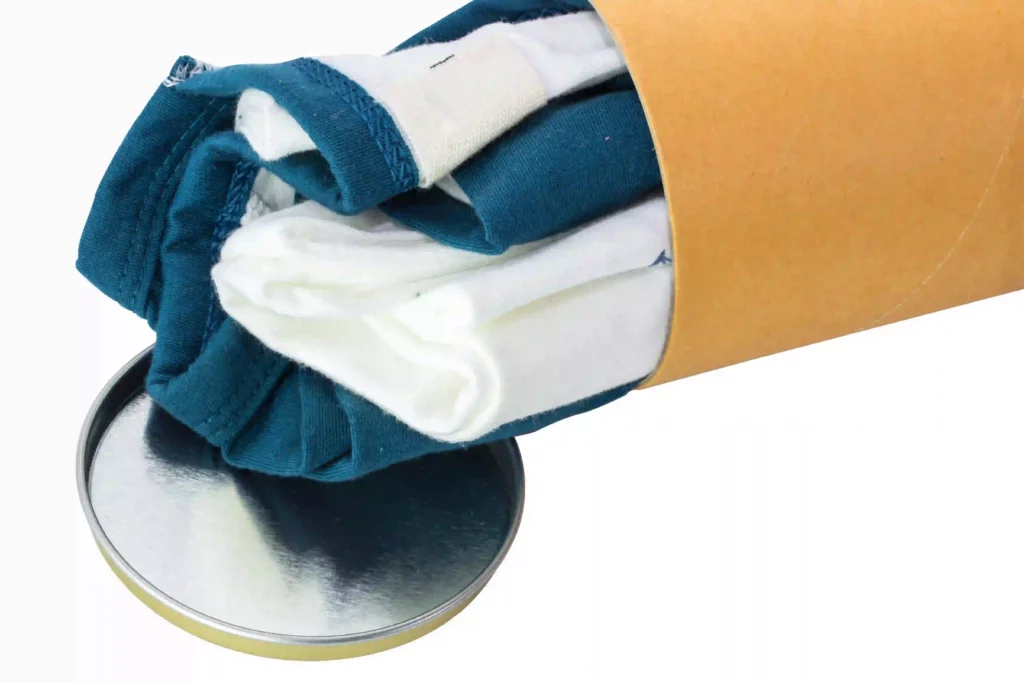
Shipping Fabric Rolls: Getting the Tube Specification Right
When cardboard tubes are used to ship fabric rolls through a courier or freight network, the demands on the tube are different from those in a production or storage environment. Tubes in transit will be handled multiple times, stacked under other consignments, and exposed to varying conditions across their journey.
For shipping applications, the tube needs to protect the fabric not just from direct impact but from the cumulative effect of handling, stacking pressure, and movement in transit. A tube that is too lightweight for the roll weight it is carrying can gradually deform during a long-distance shipment, which can distort the roll and cause creasing or compression marks on the fabric.
We have found the following practical points to be most relevant when specifying tubes for textile shipping:
- Wall thickness should reflect the weight of the finished roll, not just the fabric itself. A heavy roll of upholstery fabric or carpet will place considerably more load on a tube than a roll of lightweight lining fabric, and the wall specification should reflect this.
- End caps or plugs should be fitted to protect both ends of the tube during transit. Open-ended tubes are vulnerable to impact damage at the ends, which can cause the tube to split or distort, and they offer no protection against the fabric working loose during handling.
- Tube length should be long enough that the fabric roll does not overhang the ends of the tube, as overhanging material is at risk of edge damage during transit and handling.
For businesses shipping high-value fabrics, it is worth treating the tube specification as carefully as any other part of the packaging process. The cost of a damaged roll of fabric will always outweigh the cost of a correctly specified tube.
Ordering Considerations for Textile Businesses
Textile and fabric businesses tend to be consistent repeat buyers of cardboard tubes. This makes the supply arrangement itself worth thinking about, not just the individual order.
At Essex Tube Windings, we manufacture cardboard tubes across more than 100 diameters, with bespoke orders produced and despatched within a 3- to 5-working-day lead time. We do not enforce a minimum order quantity, which means businesses of any size, from small fabric merchants to large-scale manufacturers, can order in quantities that genuinely match their operational needs.
For businesses ordering regularly, consistency across batches matters. Dimensional variation from one order to the next can affect production setup, storage racking, and the quality of finished rolls. Confirming how your supplier maintains tolerances across repeat orders is a straightforward but important question to ask before establishing a supply arrangement.
All tubes manufactured at Essex Tube Windings are made from recycled materials, are fully recyclable after use, and are produced in a chemically waste-free process. For textile businesses working towards sustainability commitments or supply chain environmental targets, cardboard tubes compare well against plastic alternatives on all material and end-of-life measures.
What to Check Before You Order
Before placing an order for cardboard tubes for a textile application, we recommend confirming the following:
- The internal diameter required, particularly if the tube will be used on production machinery where precise fit to a spindle or mandrel is needed.
- The wall thickness appropriate for the fabric weight, roll size, winding tension, and handling conditions the tube will be exposed to.
- The required length, including any allowance for machine fittings, end caps, or the working width of the material being rolled.
- The outer surface finish is required, particularly if delicate or high-value fabrics will be in direct contact with the tube during extended storage.
- Whether end caps or plugs are needed to protect rolls during shipping and handling.
The Right Tube Makes a Real Difference
A well-specified cardboard tube is not a premium addition to a textile operation; it is a basic requirement for protecting material, maintaining roll quality, and keeping production running smoothly. The wrong tube can cause fabric damage, production downtime, and customer complaints that are far more costly than a correctly specified order would have been.
Whether you need tubes for production winding, warehouse storage, trade distribution, or retail presentation, getting the specification right from the outset is what ensures your fabric arrives in the same condition it left in.
Get in touch with our team today to discuss your requirements. We manufacture cardboard tubes to your exact specification, with no minimum order quantity and lead times from 3 to 5 working days.
Frequently Asked Questions (FAQs)
1. What diameter cardboard tube should I use for storing fabric rolls?
The right diameter will depend on the type of fabric and how tightly you need to roll it. As a general guide, a wider diameter tube creates a gentler curve when the fabric is wound around it, which is preferable for heavier materials or delicate fabrics that can be marked or distorted by tight rolling. For most commercial fabric storage applications, internal diameters of 50mm to 100mm cover the majority of use cases, but if you are working with particularly heavy rolls or sensitive materials, it is worth discussing the specific application with your supplier before ordering.
2. Can cardboard tubes be used in textile machinery, and do they need to meet any specific tolerances?
Yes, cardboard tubes are widely used in looms, spinning machines, and finishing equipment across the textile industry. When used in machinery, dimensional accuracy is critical; the tube must fit the spindle or mandrel precisely to seat correctly and perform without slipping or vibrating during the winding cycle. If your equipment specifies a particular bore size or tolerance, this should be confirmed with your manufacturer at the point of ordering rather than assumed from a standard product listing.
3. How do I protect fabric from being marked by the tube surface during storage?
For most commercial fabrics, a smooth-finished tube of appropriate diameter will not cause marking under normal storage conditions. For delicate fabrics, particularly fine weaves, silks, velvets, or any material with a susceptible pile or surface, a smoother outer finish on the tube is worth specifying. Adding an interleaving layer of acid-free tissue or washed cotton between the tube surface and the fabric is a common practice for high-value or archival textile storage and provides an additional layer of protection where needed.
4. Do I need end caps on tubes used for shipping fabric rolls?
Yes, for shipping applications, end caps or plugs are strongly recommended. Open-ended tubes are vulnerable to impact damage at both ends during handling and transit, which can cause splitting or distortion that affects the entire roll. End caps also help keep the fabric securely in place and prevent it from working loose during the journey. The right end cap type, whether a push-fit plug or a fitted cap, will depend on the tube diameter and the weight of the roll being shipped.